
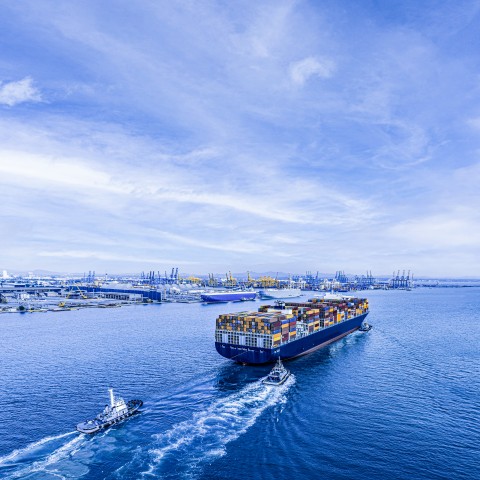
Full Container Load (FCL) or Less Than Container Load (LCL) – The Right Solution for Every Shipment
We organise your sea freight shipments as Less Than Container Load (LCL) or Full Container Load (FCL) services through DACHSER logistics centres at key ports around the world. Our services include weekly departures, collection and delivery through the DACHSER European Logistics network, and distribution to destinations worldwide. In addition, our warehouse network offers storage solutions combined with a wide range of value-added services.
Our sea freight solutions at a glance


Our sea freight services
- Project cargo shipments
- Comprehensive logistics solutions including customs clearance and insurance
- Organisation of pre-carriage and onward transport for your sea transport operations
- Buyer’s and Seller’s Consolidation with a focus on Europe and APAC
- Extensive warehouse network with a wide range of value-added services
- Industry-specific and specialised logistics solutions
- Development of customised logistics concepts for optimised supply chain management
- Expert advice on security regulations, packaging, equipment and documentation
- Comprehensive service portfolio
- Secured capacity agreements with selected shipping lines

Process quality for international sea freight shipments
DACHSER Network Management
The foundation of DACHSER Air & Sea Logistics is a global network of company-owned locations. Coordinated by a global sea freight management team and supported by local experts, this network enables efficient consolidation and transport worldwide.
- Connections to strategically important ports in the Americas, Africa, Asia and Europe
- Scheduled frequencies for maritime transport
- Flexible loading options with secured capacities
- Efficient freight handling
- Global network, local expertise
- Globally standardised processes
DACHSER Global Preferred Carrier Strategy
Whether sea freight, air freight, rail or road transport, DACHSER is committed to delivering consistent logistics quality across every point in the supply chain. We work exclusively with selected shipping lines and LCL partners that meet our standards for quality, efficiency and reliability.


Incoterms for sea freight
The attached PDF provides an overview of Incoterms 2020 for sea freight applications and supports daily operational activities. It covers relevant maritime trade terms including FOB Incoterm, CIF Incoterm, CFR Incoterm and FAS Incoterm.
Frequently asked questions about sea freight and sea freight logistics
What do FCL and LCL mean?
Full Container Load (FCL) and Less Than Container Load (LCL) describe the two main methods of transporting cargo in containers.
- FCL refers to a full 20-foot or 40-foot container. This option means that a container is reserved exclusively for your shipment. FCL is typically used for large cargo volumes or particularly sensitive goods.
- LCL is a consolidation container that carries cargo from multiple customers. By sharing container space, available capacity is utilised more efficiently. For smaller shipment volumes, LCL shipping is often a more cost-effective and sustainable option.
Which Incoterms apply to sea freight?
There are four Incoterms that are used exclusively for sea freight and Maritime Transport:
- FAS Incoterm (Free Alongside Ship): The seller is responsible for delivering the goods from their premises to a location alongside the vessel. The buyer assumes responsibility for loading, transport, insurance and unloading costs.
- FOB Incoterm (Free On Board): The seller is responsible for delivering the goods to the vessel and loading them on board. Once the goods have been loaded, responsibility for transport and insurance transfers to the buyer.
- CFR Incoterm (Cost and Freight): The seller covers the transportation costs from origin to the port of destination.
CIF Incoterm (Cost, Insurance and Freight): The seller covers both transportation and insurance costs from origin to the port of destination
The following Incoterms apply across all transport modes and are also frequently used for Less Than Container Load (LCL) shipments:
- EXW (Ex Works): The seller makes the goods available at their premises. The buyer assumes all costs and risks from that point onwards, including transport, customs clearance and insurance.
- FCA (Free Carrier): The seller delivers the goods to an agreed location and is responsible for export customs clearance. All subsequent transport, insurance and unloading costs are borne by the buyer.
- DAP (Delivered at Place): The seller covers transport costs to the named place of destination.
- DDP (Delivered Duty Paid): The seller covers transport costs, customs clearance and import duties up to the agreed destination.
- CPT (Carriage Paid To): The seller pays transport costs to the agreed destination. Risk transfers to the buyer once the goods have been handed over to the first carrier.
- CIP (Carriage and Insurance Paid To): The seller covers transport and insurance costs to the agreed destination. Risk transfers when the goods are handed over to the first carrier.
- DPU (Delivered at Place Unloaded): The seller bears all costs and risks until the goods are unloaded at the agreed destination. The buyer assumes responsibility after unloading.
What are the advantages of sea freight?
Without sea freight, transporting large quantities of goods over long distances would often not be possible. In addition, sea transport offers several advantages:
- Cost-effective: Sea freight is generally more economical than air freight or rail freight, particularly for large shipment volumes.
- Flexible: Almost any type of cargo can be transported, including oversized goods, bulk cargo, dangerous goods and sensitive products.
- Secure: Based on cargo insurance claims, sea freight is considered one of the safest forms of international transport.
- Lower emissions: Compared with air freight, Maritime Transport produces significantly lower CO₂ emissions relative to the volume of goods transported.
How is sea freight shipped?
Depending on the type and volume of goods, cargo can be transported as bulk cargo or containerised freight.
For containerised shipments, customers can choose between:
- Full Container Load (FCL)
- Less Than Container Load (LCL)
The choice between FCL Shipping and LCL Shipping depends on shipment volume, cargo requirements and delivery schedules.
How should sea freight be packaged?
As the shipper, you are responsible for ensuring that your cargo is packaged securely to withstand shocks, vibrations, temperature fluctuations and other external influences encountered during transport.
Container cargo is typically packed on wooden or plastic pallets or in plywood crates. Packaging must be sufficiently robust, as cargo is often stacked within containers. Temperature-sensitive goods may require insulated packaging or refrigerated containers.
How are sea freight rates calculated?
For LCL sea freight, pricing is based on shipment dimensions (cubic metres/m³) and weight (metric tonnes).
Shipping rates are often expressed as:
- M/G (Measurement/Weight)
- W/M (Weight/Measurement)
Charges are calculated using whichever factor produces the higher freight value.
- Bulky but lightweight cargo is generally charged according to volume.
- Dense and heavy cargo is usually charged according to weight.
For FCL shipping, pricing is generally quoted either per container or per TEU (Twenty-foot Equivalent Unit).
Which pallets are suitable for sea freight?
Standard Euro pallets used for road transport are not ideally suited to container transport because the internal dimensions of shipping containers differ from those of European trailers.
For sea freight, specialised container pallets are often recommended. Pallets measuring:
- 1140 × 1140 mm
- 760 × 1140 mm
allow efficient use of container space.
Container pallets are available in wood, pressed board or plastic. Pressed board and plastic pallets offer the additional advantage of stackability. Euro pallets can still be used, although this may reduce loading efficiency. Wooden pallets must comply with international treatment regulations.
What shipping container types are available?
The majority of sea freight shipments are transported in standard dry containers.
The most common Shipping Container Types are:
- 20-foot container
Internal dimensions: 5.6 m × 2.35 m × 2.39 m - 40-foot container
Internal dimensions: 12.03 m × 2.35 m × 2.39 m - 45-foot High Cube container
Internal dimensions: 13.55 m × 2.35 m × 2.70 m
Additional container types include:
- Open Top containers for oversized cargo loaded from above.
- Flat Rack containers for heavy machinery and industrial equipment.
- Platform containers for cargo exceeding standard container dimensions.
- Refrigerated containers (Reefers) for food products, flowers and temperature-sensitive goods.
- High Cube containers offering approximately 30 cm of additional internal height.
Which documents are required for sea freight shipments?
Required shipping documents generally include:
- Commercial Invoice – the basis for customs clearance.
- Packing List – detailing cargo items and package identification.
- Customs Declaration – export or import documentation based on the commercial invoice and packing list.
- Bill of Lading (B/L) – the contract of carriage and document of title for the goods.
- Sea Waybill – a sea freight transport document similar to a Bill of Lading but without document-of-title functionality.